Best Non-Contact Voltage Testers – Safety First When Working on Circuits

The Klein NCVT-5P is the most complete non-contact voltage tester with its positive safe indicator; the Fluke VoltAlert is the trusted pocket reference that every electrician and serious DIYer should carry.
As an Amazon Associate, we earn from qualifying purchases.
Before you touch any wire, outlet, switch, or electrical fixture, you need to know whether it is live. Non-contact voltage testers (NCVTs) answer that question in a fraction of a second without touching the conductor – just hold the tip near the wire, and a beep plus light tells you power is present. This single habit – test before you touch – prevents the electrical accidents that send DIYers and professionals to the emergency room every year.
How Non-Contact Voltage Testers Work
An NCVT uses a capacitively-coupled sensor that detects the electromagnetic field radiating from an AC voltage conductor. When the sensor comes within an inch or so of an energized wire or conductor, the field is strong enough to trigger the detector’s alarm circuit – producing an audible beep and a visual indicator (LED light). No contact with the conductor is required.
NCVTs detect AC voltage only. They do not detect DC voltage, which is fine for residential electrical work (all line voltage is AC) but means they cannot be used to check battery-powered DC circuits.
Sensitivity Levels
Better NCVTs offer selectable sensitivity:
- High sensitivity: Detects voltage through walls, conduit, and multiple layers of insulation. Useful for tracing wire runs but prone to false positives near wiring that is not the specific wire you are testing.
- Low sensitivity: Requires close proximity to the conductor. Better for confirming a specific wire is de-energized when adjacent energized wires are present.
A tester with dual sensitivity is far more useful than a single-sensitivity model.
Key Features to Look For
Sensitivity Range
At minimum, detection of 90V to 1000V AC for residential work. Some testers are also rated for 12 to 1000V (for low-voltage lighting circuits).
Visual and Audible Alerts

A bright LED indicator is readable at arm’s length or in bright light. The audible beep is essential in noisy environments. Both together provide redundant confirmation.
CAT Safety Rating

Like multimeters, NCVTs carry CAT ratings. CAT III 1000V is the minimum for work in electrical panels and service boxes. CAT IV is recommended for work at the service entrance.
Auto Power-Off
A tester that powers off after a few minutes preserves battery life and means the tool is never accidentally left on in a tool bag where battery drain goes unnoticed.
Ghost Voltage Mode

Some testers have a “ghost voltage” or low-impedance mode that ignores capacitively coupled voltages that appear on conductors not truly energized. Without this mode, a tester may indicate voltage on a wire that is actually de-energized but picking up induced voltage from adjacent conductors.
Our Top Picks
1. Klein Tools NCVT-5P Non-Contact Voltage Tester
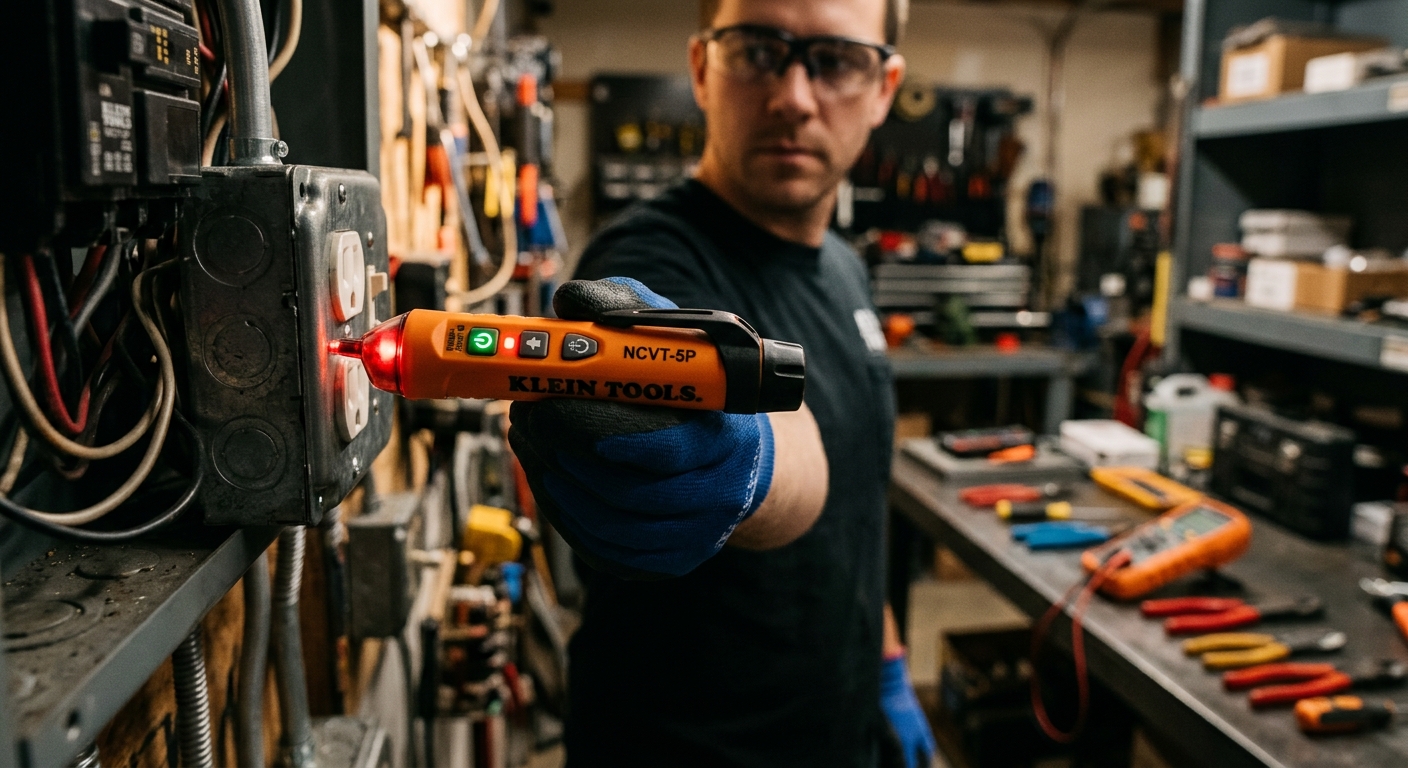
Klein’s flagship NCVT combines dual sensitivity (12 to 1000V and 90 to 1000V), a very bright 5-LED indicator, audible alarm, CAT IV 1000V rating, and the SmartLight indicator that glows green when no voltage is detected – providing positive confirmation of a de-energized conductor, not just absence of alarm. The positive safe indicator is an important safety improvement over testers that only beep when voltage is present.
2. Fluke 1AC-A1-II VoltAlert

The single most popular non-contact voltage tester in the trade. Simple one-LED plus beeper operation, 90 to 1000V range, AAA battery power, and Fluke quality and accuracy. The pencil-thin form factor fits easily in a shirt pocket or clips to a tool belt. Electricians have trusted the VoltAlert line for decades – this is the tester that serves as the benchmark in the category.
3. Milwaukee 2202-20 Laser Temperature and Non-Contact Voltage Tester
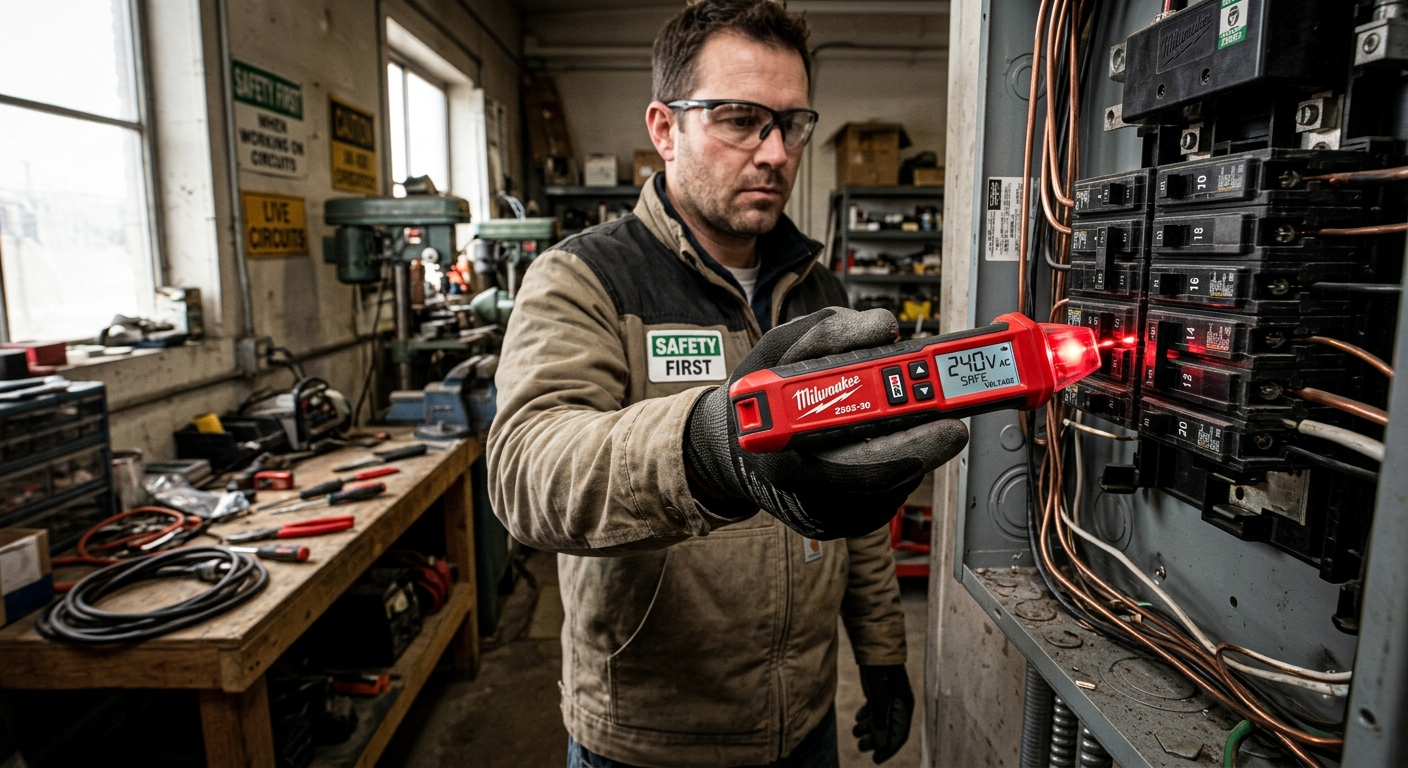
A multi-function tool that combines non-contact voltage detection with a non-contact infrared thermometer. Useful for identifying hot wiring insulation, overheated breakers, and thermal anomalies in electrical systems alongside voltage testing. The combination makes sense for homeowners who want fewer tools to carry.
4. Gardner Bender GVD-3504 Dual Range Non-Contact Tester

An excellent mid-range dual-sensitivity NCVT. The two-range design handles both low-voltage (24V to 90V) and standard residential (90V to 1000V) detection. Very bright LED, clear audible alert, and CAT III 600V rating. A reliable and affordable choice for homeowners who occasionally work on electrical systems.
5. Sperry Instruments STK001 GFCI Outlet Tester and NCVT Combo

A combination product that includes both a non-contact voltage tester and a GFCI outlet tester. A smart pairing for homeowners who want both tools in one purchase.
Safe Testing Procedures
Use your NCVT according to this protocol before touching any conductor:
- Verify the tester is working by testing a known live conductor first (a plugged-in lamp cord).
- Test the conductor you intend to work on.
- If the tester indicates no voltage, treat it as confirmation, not certainty – test with a multimeter as a second verification for panel work.
- After any work, test again before restoring power to confirm connections are correct.
What to Avoid
- Testers with no CAT rating: These are not safety-rated for line voltage environments and may fail to protect you from transient surges.
- Single-sensitivity testers only: Without low sensitivity mode, you get false positives near adjacent wiring that make it impossible to confirm a specific wire is de-energized.
- Using only an NCVT for panel work: Always confirm with a multimeter before touching any conductor in a panel. NCVTs can miss de-energized conductors that are picking up ghost voltage.
FAQ
Will an NCVT work through drywall to detect wiring?
On high sensitivity mode, many NCVTs detect voltage through 1/2-inch drywall from wires carrying full line voltage. This is useful for locating wire runs before drilling or cutting. It is not a reliable substitute for a stud finder or wire tracer.
My NCVT beeps near outlets that look dead. Why?
Ghost voltage – induced AC voltage on non-energized conductors from adjacent live wiring. Switch to low sensitivity mode or use a low-impedance tester, which discriminates between true energized conductors and capacitively induced ghost voltages.
Do I need both an NCVT and a multimeter?
Yes. The NCVT provides fast, safe voltage presence/absence confirmation without contact. The multimeter provides quantitative measurement (what is the voltage?), continuity testing, resistance, and diagnostics the NCVT cannot perform. They are complementary tools, not alternatives.
Affiliate Disclosure: DIY Arsenal participates in the Amazon Associates Program and other affiliate programs. When you purchase through links on this site, we may earn a small commission at no additional cost to you. We only recommend products we have personally tested and genuinely believe in.